
Founders are easily the most valuable asset a company has and also the most underutilized, especially in small businesses and startups.
But the founders and small business owners who embrace a personal brand aren’t just going to see “better engagement” or “more followers.” They’re going to see real results in their marketing, sales conversations, and overall business growth over the next several years.
This isn’t just a hunch. There’s hard data and real-world experience behind it.
Let’s Start With the Data
Before we get into anecdotes or opinions, let’s anchor this in reality.
One of the most important data points I reference when talking about founder-led brands is this:
82% of people are more likely to trust a company when its leadership is active on social media. (Edelman Trust Barometer)
That alone should stop most founders in their tracks.
On top of that:
65% of Gen Z prefer to buy from brands where they know the founder or the story behind the company. (5WPR Consumer Culture Report)
Here’s why that matters more than some people realize: the oldest members of Gen Z are already nearing 30. Over the next few years, they’ll increasingly sit in management roles, decision-making seats, and stakeholder positions.
We are no longer operating in a traditional funnel world. We are operating in a trust economy.
Trust is no longer something that gets layered in after the fact. Trust is the entry point. It’s the filter people use before they ever book a call, request a proposal, or take your brand seriously.
When people see you — not just your logo — on social media, podcasts, guest articles, or long-form content, something important happens. They feel like they know you. Whether that’s objectively true or not, the perception matters and drives behavior.
Greater connection and trust lead them to be far more likely to do business with your company.
Trust Is Currency, Especially in Saturated Markets
I own a marketing company. It doesn’t get much more saturated than that.
We can talk about differentiation all day long — better processes, better portals, better systems — and yes, those things matter. We do excellent work. We have a cool portal. We care deeply about execution.
But when I really step back and ask myself why clients choose us and stay with us, it’s not because of those things.
It’s because they trust us.
Our leadership, integrity, and that we’ll do what we say we’re going to do.
Our world is being completely reshaped by AI, and technology is changing everything we know about business. That’s why human trust has become insanely valuable.
Trust is now currency.
Your Reputation Impacts More Than Just Marketing
The value of founder visibility doesn’t stop at lead generation.
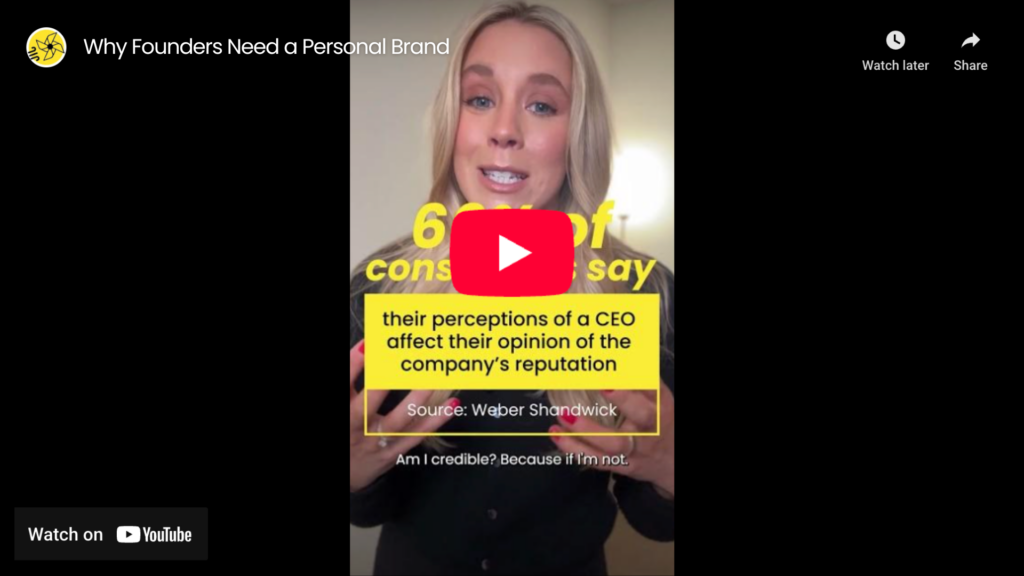
- 66% of consumers say their perception of a CEO affects their opinion of the company’s reputation. (Weber Shandwick)
- Nearly 50% of a company’s market value is tied to the CEO’s reputation. (Weber Shandwick)
- A positive CEO reputation attracts employees (77%) and helps retain employees (70%), per executives surveyed. (Weber Shandwick)
This isn’t just a marketing or sales lever. It touches hiring, culture, credibility, and long-term growth.
You’re not just shaping decisions for your company, but the perception of it.
What I Saw When I Finally Stepped Out Front
As a founder myself, I knew I should be more visible for years.
I knew I should treat myself as an asset to my business and build a personal brand alongside the company brand.
But impostor syndrome, busyness, and everything else got in the way.
When I finally made the shift, the changes were noticeable, not just internally, but operationally.
I started seeing things like this:
A lead would come in through our website. An hour later, that same person would view my LinkedIn profile.
Instead of feeling uncomfortable about that, I felt relieved.
Because that sales call just got easier.
If they still wanted to talk, they already knew who I was. They understood my perspective, could see my credibility, and I knew I wouldn’t have to“prove myself” from scratch.
People look up founders often, especially in small businesses and startups. When brand equity isn’t deeply established yet, people don’t trust logos. They trust people.
But if a founder’s profile is empty, inactive, or misaligned with what the company claims to stand for, it creates friction, even if the service itself is solid.
A Client Example That Made This Crystal Clear
One of my favorite examples of this comes from a client with a fractional CFO firm.
His ideal clients were high-earning business owners — people making between $750K and $5M a year. These are sophisticated buyers with a lot of assets and options, meaning they are extremely trust-driven.
When we started working together, he was still positioned behind the company logo. But strategically, that didn’t make sense.
Because the clients he wanted weren’t buying a generic CFO service. They were buying his judgment, experience, and authority.
So we repositioned the content around him.
We spoke directly to the people he served. We showcased how he thought. We made his expertise visible.
The result? Stronger engagement, better conversations, and real business momentum, along with some seriously improved social media metrics.
“Okay, I’m Ready to Build My Personal Brand. What Do I Actually Do?”
This is the question I get most often. If I had to start my personal brand from scratch today, here’s exactly what I would do.
1. Pick One Platform and Post Three Times a Week
Choose the platform where your audience already spends time. Commit to three posts a week — text, video, images, and reposts all count.
You can expand and repurpose later. Right now, consistency beats complexity.
2. Block Creation Time Like a Client Meeting
If it’s not on your calendar, it won’t happen.
I create on the same day, at the same time, every week. If I need to miss a week, I double up ahead of time. Treat content creation like a non-negotiable because it is.
3. Get Help Earlier Than You Think You Should
This doesn’t mean hiring a massive team.
It might mean leaning on an assistant, working with a strategist, or a small, scalable support system.
Maybe you need execution, or maybe you just need clarity and direction. Either way, get help so you can save months of trial and error.
4. Create for Your Buyer, Not Your Peers
This is a big one. It’s tempting to create content that gets quick validation from industry peers. There’s nothing wrong with that, but it can’t be the point.
Your goal isn’t engagement, but trust, visibility, and opportunity for your business.
Create for the people who will actually hire you.
5. Use Content as Leverage
Your content isn’t just for social media.
It becomes…
- Podcast pitches
- Guest articles
- Speaking opportunities
- Proof of expertise.
Content is evidence, and it builds trust faster than claims ever will.
Start Investing in Yourself as a Founder
If you haven’t invested in yourself as a founder and you haven’t been using yourself as the asset you already are, it’s time to start.
Not for vanity or ego, but because your presence directly impacts trust, growth, and opportunity for your business.
In a trust economy, that matters more than ever.
If you’re looking for help starting to build your personal brand, let’s talk.